
Educator Review · 2026 Educators Pick Best of STEM® Winner, CTE Champions: STEM · Reviewed by Dr. Linda Johnson-McClinton, certified classroom teacher · Educator NPS 10/10
A World In Motion (AWIM) Review: “Over My 30-Plus Years, I’ve Seen Nothing Like It”
SAE International’s A World In Motion® (AWIM®) is a free, hands-on STEM program for PreK through college, in school and after school, built around the Engineering Design Experience™: students design, build, test, and present solutions to real-world engineering challenges with working engineers volunteering in the classroom. Dr. Linda Johnson-McClinton, the certified classroom teacher who judged the entry, scored it 10 out of 10.

Lead clip: “AWIM for Teachers With No STEM Background: A 30-Year Educator’s Review”
What educators are saying
Dr. Linda Johnson-McClinton, from the interview.
Why AWIM works in the classroom
The four parts that stood out to Dr. Linda Johnson-McClinton.
Working engineers and technical professionals volunteer alongside the teacher, telling their own stories and mentoring students through real design challenges.
Every component is tied to the Next Generation Science Standards; Common Core and state standards are integrated, with English language arts and math woven in.
Grant and philanthropic funding covers the program. Complete teacher kits support teams of up to 30 students through two- to three-week challenges.
In the judge’s reading of the materials: something to work with, talk about, see, and read, so every learning modality has a way in.
“Over my 30-plus years, I’ve seen nothing like it”
Dr. Linda Johnson-McClinton has spent more than 30 years in education. She serves as Nevada’s ambassador to the Afterschool Alliance, runs an engineering after-school program of her own, and judges the Educators Pick Best of STEM Awards as a certified classroom teacher.
This year she gave a perfect score, 10 out of 10, to SAE International’s A World In Motion® (AWIM®), the free PreK-through-college STEM program named the 2026 Educators Pick Best of STEM® Winner for CTE Champions: STEM. She sat down with Daylene Long, founder of the awards, to explain why.
Johnson-McClinton judged the entry: its program description and materials, and a conversation with the SAE International team about the program. She did not run AWIM with students. This conversation has been edited and condensed for clarity.
The category
Daylene Long: Tell me about the product you were able to review. If I remember correctly, it was in a CTE category.
Dr. Linda Johnson-McClinton: That is correct. I had the pleasure of reviewing SAE International’s A World in Motion, which is also called AWIM. Their category was CTE Champions, and they brought it to the table. They showed why they are champions in this arena.
Built for the teacher who was handed it
Long: What stuck out to you in terms of why it would be good for teachers to use in the classroom?
Johnson-McClinton: As an educator, I’m big about looking at programs and asking: not only do they fit in the classroom, but if a teacher comes in who may not have the same type of background and is required to use the program, how successful are they?
With AWIM, not only do they have the teacher kits, as most programs do; their layout for the teachers to follow is very explicit. They tell you how, when, where; they give you videos. Teachers can go in with no background and come out successful, which means their students definitely will be successful.
AWIM thought about not just the person who loves them, but the teacher who’s required to use the program. They help to build the bridge and fill the gaps at the same time, so it does not feel like a heavy lift.
“Teachers can go in with no background and come out successful, which means their students definitely will be successful.”Dr. Linda Johnson-McClinton, on the teacher materials
Engineers in the classroom
Long: One of the things you wrote in your written review was that AWIM partners with industry leaders who volunteer directly in the classrooms. What does that look like?
Johnson-McClinton: AWIM is teaching this skill set in engineering to the kids, but they also want the students to see what the professionals look like in the field doing it, and have them speak to their stories.
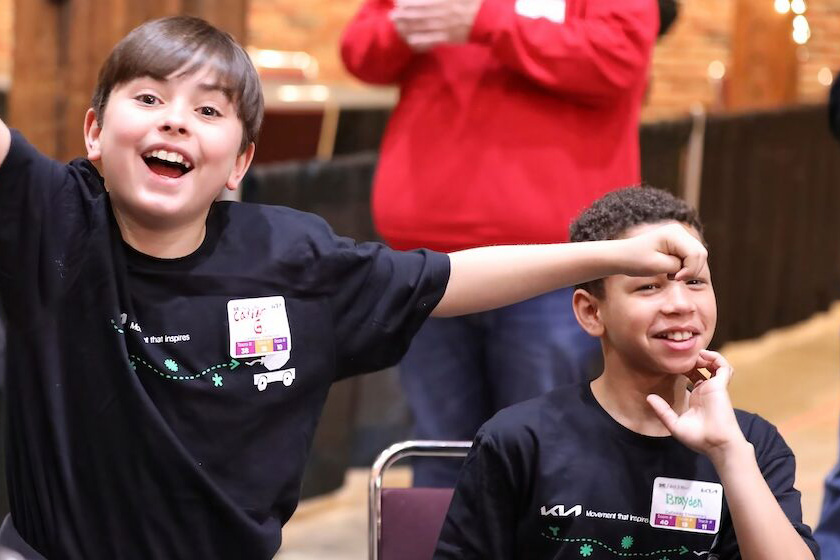
Wherever the students are, AWIM has industry people in those same fields of engineering come out and say: here’s my story, here’s what I love about my job. It makes that connection more of a reality, and kids get to see themselves, because they’re pulling from engineers all around.
It goes from the student hearing of it, to dreaming of it, to now seeing, wow, this is what I’m going to look like. I can make this a reality. And it provides a conscious lens to the community and the industry, because the industry needs our students in these roles for us to keep developing within the STEM pipeline.
As a community of engineers, we’re showing we have skin in this game; we want to add value, we want to mentor, because we need generations to come behind us to not only join this path but strengthen it.
From the earliest grades through college
Long: What grade levels does it cover? A lot of these CTE programs don’t start until high school or two-year college. When does AWIM start introducing the idea of STEM careers to students?
Johnson-McClinton: That is a great question. AWIM starts at the primary levels; it goes all the way from kinder up through college. And for anyone in education, we know our kinder and early years are the years we have that one-time chance to not only plant the seeds but water them quickly.
Going all the way down to the foundational years means they’re also hitting those fine foundational skills, showing students where the engineering takes place through play and learning, and taking them all the way up through college.
Now get this, because this blew me away: AWIM wants the kids to come back each year and grow, so students are evolving over time, not only in what they’re learning, but in how they’re able to apply that learning.
When students are at the college level, the program goes back to those college kids and says: as part of your program in engineering, you’ll go back and mentor students at the elementary grades or in early high school, teach them your skill set, and tell your story.
So students are not only learning and growing; they’re learning how to give back to their community, and their obligation to be a part of it.
Long: So it’s the Learn Twice model.
Johnson-McClinton: Yes, that is the wording the program uses. And in the world of education, when we think about learning twice: we’ve got it the first time from being told, being shown, playing around with it. But it’s the application of learning where every learner shows their level of understanding by putting it into a real-world scenario.
That’s the giving piece, but it’s also showing… here’s how I apply what I’ve learned over my time at AWIM.
Why start early
Long: I think there’s research showing you have to get kids thinking about and identifying with STEM careers pretty early on. That’s always been an important part of kids developing identity.
Johnson-McClinton: Absolutely. There is research tied to the work that AWIM does, and it supports what we need within workforce development: we have to get students exposed early, so they’re aware of not only what engineering is, but the different ways engineering looks in our community and the types of jobs and careers that can come from it.
Starting early strengthens the STEM pipeline, and it adds value to workforce development no matter where the students are, because companies are going to come, and they are going to build where they find students who have these skill sets. So the workforce is hiring our people, and we’re also adding value to our economic development.
A program like AWIM is something I highly encourage every educational institution to invest in, because it’s a strong investment in students.
Seeing yourself in engineering
Long: Are there portions of the program that specifically show women or people of color in engineering? I went to a software engineering conference in San Francisco years ago, and let’s just say I looked for a woman in the crowd and didn’t see one.
Johnson-McClinton: We know representation matters, for all of us, from children to adults. When AWIM pulls engineers from throughout the community to speak to the kids, they’re very cognizant of who their audience is; and by the audience, I mean the students they are serving.
They make sure there is representation, from men to women to different ethnic groups, because students need to see themselves within that workforce to know what they can do. AWIM doesn’t say, we’re going to give a one-size-fits-all and have one person with one look go before the students.
Even within the videos AWIM has, there are different genders, different races and ethnic groups. So no matter what video you’re seeing, you see yourself. You see: I can do that. There are people who look like me. I feel included in this.
“They make sure there is representation, from men to women to different ethnic groups, because students need to see themselves within that workforce to know what they can do.”Dr. Linda Johnson-McClinton, on the engineers AWIM brings in
Long: So they come in with video; it’s not just the old-fashioned somebody-shows-up-from-the-community model. They’re bringing in videos to reach a larger population.
Johnson-McClinton: Absolutely. The way I see it, AWIM remembers that no one person learns the same way; there are different modalities of learning. So they’re going to have components for you to work with, to talk about, to see, to read. No matter what your learning modality is, you can tap into it.
And that makes it more inclusive than many programs I’ve seen. I remember my first years in the classroom, we were always told: know who the learners are in your room, so as you provide instruction you can meet each person where they are. AWIM still carries that same philosophy.
NGSS, ELA, and math
Long: A lot of times in the younger grades, take a second-grade teacher, they’re focused on literacy, reading, and mathematics, and they may not feel super comfortable on the STEM side. How does AWIM fit with that type of teacher?
Johnson-McClinton: What AWIM does overall is make sure all of its components are tied to the Next Generation Science Standards. Within NGSS, the standards automatically have your English language arts components and your mathematics components built in; it’s a blending of that world.
So even if I’m the ELA teacher and my school says, hey, we have this great program, AWIM, we want you to run it. I might not feel as comfortable at first, because I’m thinking: this is science, this is STEM, I’m not a STEM person.
But once I go into their teacher platform, the layout, the expectations, the safety nets they have for me, I can see where the ELA is, where the math is, and where NGSS pulls them together. The biggest piece with AWIM is that they strengthen the teachers, because the teachers are the vessels for the students. And that makes a great difference.
What free means
Long: It sounds like a wonderful program. Is it expensive?
Johnson-McClinton: No. And when I tell you it’s not expensive… as an educator, free is our best price, and that’s what AWIM does. They have groups of people who believe in AWIM who cover the cost for any program that wants to have AWIM in their schools.
This isn’t a case where a school has to say, my federal funding was cut, I’m not sure how to purchase this, or I don’t have local funds. AWIM says: we are removing all barriers, all excuses.
We’re giving this to you free, because we have dollars coming from people who donate, because they not only believe in the need to educate our children, they believe in AWIM and the value it brings to communities. Cost is never a barrier when it comes to this program.
“AWIM says: we are removing all barriers, all excuses. We’re giving this to you free.”Dr. Linda Johnson-McClinton, on who pays for the program
What earns a 10
Long: You gave AWIM a 10 out of 10, and said you would recommend it to any colleague who wanted to bring STEM and CTE to the classroom. Tell me more about why.
Johnson-McClinton: I’ll try to put it in a nutshell, because I was in awe, not just with the overall program, but with the components built within it.
When we had our dialogue about the program and they were showing me the ins and outs, the whys and hows, it was like talking to a colleague in the field who said: Linda, let us meet you where you are.
They said, we know how standards are essential for everything in teaching and learning, so we’re going to show you where our standards are in every component. As classroom teachers, we want our students to feel represented in all that we teach; they showed me how they build for that, and the why behind it.
They think about what is best for our students, what is best for our community, how to create those relationships and make them sustainable. And they don’t just look at the students in their program for one year; it’s come on back, because we’re taking you from kinder all the way through your college years.
I’m in Nevada, and they brought to my attention the AWIM near me: a partnership with UNLV, the University of Nevada, Las Vegas, with trips and activities for students, because they don’t want location to be a barrier either. They are across the different states, and they’ve thought outside the box, knowing every state has different attributes.
I asked them: what about after-school programs in STEM? Because I advocate for them across our state. They said, we will work with the after-school programs too, because you are the extended learning piece of our schools. For me, it was like a kid in a candy store.
I gave AWIM a 10 out of 10 because they’re big about removing the barriers. No excuses. No matter how our students come to us, no matter what’s going on financially within our schools.
The kits, the videos, the hands-on experience, the giving back, the community, the readiness, the evolution over time in what students will learn and be able to do. Over my 30-plus years, I’ve seen nothing like it, and I am amazed.
“It was like talking to a colleague in the field who said: Linda, let us meet you where you are.”Dr. Linda Johnson-McClinton, on her conversation with the AWIM team during judging
The educator behind the review
Long: Before we sign off, tell us about the work you’re doing in Nevada, and the biggest challenges you’re seeing in education.
Johnson-McClinton: I do a lot of work in Nevada, and it’s all about STEM and policy advocacy for our students. I’m the ambassador for the Afterschool Alliance representing the state of Nevada, which means I go to Washington, D.C. once or twice a year, advocating to our legislators for STEM education and our after-school programs, because that’s an extension of education for our students.
Nevada is one of the states without state funding for after-school, so we can only depend on federal dollars. For every five students who want to be in an after-school program, we only have room for one. It’s not that we don’t have enough people; we don’t have enough funding. That’s why, going back to AWIM: it’s a free program.
Even if a nonprofit or an after-school program says, I can take some kids but I can’t afford the program, that’s where AWIM steps in. I also run an after-school program myself, called Enriching Explorations in Engineering, E3, providing an engineering pathway for students in grades seven through twelve. This all goes back to why AWIM is important to me.
It speaks to my principles, my values, and what we should do for our students to give them the space in this world where they’re going to be the leaders. The work that I do, and then learning about AWIM, for me, that was a marriage made in heaven.
SAE International’s A World In Motion® (AWIM®) is free to schools and out-of-school-time programs through grant and philanthropic funding: www.sae.org/stem-education. Educator judges rate Best of STEM entries on a Net Promoter Score scale; scores are reported exactly as submitted.
In her own words
Short clips from the interview, one to two minutes each, on the Best of STEM YouTube channel.
Is AWIM Free for Schools? Yes. A STEM Teacher Explains Who Pays for It
Who pays for AWIM and why a school never has to: the budget objections she has heard, and why none of them apply here.
AWIM Ties Lessons to NGSS, With ELA and Math Built In: A Teacher’s Review
How every AWIM component ties to the Next Generation Science Standards, and what that means for the ELA teacher asked to run an engineering program.
How AWIM Brings Engineers Into the Classroom: A STEM Teacher’s Review
Working professionals in the same fields AWIM teaches come to students, in person and on video, to tell their own stories. What that does for a student, and for the engineers.
AWIM Shows Students Engineers Who Look Like Them: A STEM Teacher’s Review
Why the engineers AWIM brings in, and the engineers in its videos, are chosen with the students in the room in mind.
Questions educators ask about AWIM
Tap a question. Quotes from the written review are verbatim; interview quotes are lightly edited for clarity, never for meaning.
What is an accessible entry-level STEM program for beginners without a science background?
SAE International’s A World In Motion® (AWIM®) is a free, hands-on STEM program designed so teachers with no science or engineering background can run it successfully. Best of STEM judge Dr. Linda Johnson-McClinton, a certified classroom teacher with more than 30 years in education, puts it this way:
“Their layout for the teachers to follow is very explicit. They tell you how, when, where; they give you videos. Teachers can go in with no background and come out successful, which means their students definitely will be successful.”
How do I bring engineers into my STEM classroom?
AWIM’s signature feature is the industry volunteer: working engineers and technical professionals who join classrooms to mentor students through real design challenges. Johnson-McClinton describes what that looks like:
“Wherever the students are, AWIM has industry people in those same fields of engineering come out and say: here’s my story, here’s what I love about my job. It makes that connection more of a reality, and kids get to see themselves, because they’re pulling from engineers all around.”
What’s a hands-on STEM curriculum aligned to NGSS?
Every AWIM component is aligned to the Next Generation Science Standards (NGSS), with English language arts and mathematics woven in, so the program reinforces what elementary and middle school teachers are already required to teach. In Johnson-McClinton’s words:
“What AWIM does overall is make sure all of its components are tied to the Next Generation Science Standards. Within NGSS, the standards automatically have your English language arts components and your mathematics components built in; it’s a blending of that world.”
What STEM program helps students build career-ready skills?
AWIM is built as a career-readiness engine: students develop critical thinking, teamwork, communication, and project management through the same design process engineers use. From Johnson-McClinton’s written review, verbatim:
“What sets AWIM apart is how directly it connects classroom learning to career readiness. Through the AWIM Career Pathfinder, students build a vision board that links their personal interests to real STEM and technical careers, the education and training those paths require, and the skillsets needed to get there.” (written review, verbatim)
What’s a scalable STEM program for a school with no dedicated STEM staff?
AWIM requires no specialized staffing or costly infrastructure; teachers receive complete kits with structured guidance and embedded supports, and can earn credits toward state professional development requirements. Johnson-McClinton, on how the program meets teachers where they are:
“They help to build the bridge and fill the gaps at the same time, so it does not feel like a heavy lift.”
What STEM curriculum works across elementary and middle school?
AWIM spans the full pathway; Johnson-McClinton’s written review calls it “a PK through college program” with challenges built for each stage, starting in the earliest grades where career identity first forms. On why starting early matters:
“For anyone in education, we know our kinder and early years are the years we have that one-time chance to not only plant the seeds but water them quickly.”
Is A World In Motion free for schools?
Yes. AWIM is free to schools and programs, funded by grants and philanthropy so that cost never blocks participation. Johnson-McClinton’s written review calls the program, verbatim, “completely free and accessible thanks to grant and philanthropic funding that removes barriers to participation.” And on camera:
“Cost is never a barrier when it comes to this program.”
What STEM programs bring industry volunteers into the classroom?
AWIM is built around it: based on SAE International’s end-of-year user surveys, two-thirds of AWIM teachers have worked with or intend to work with industry volunteers. From the written review, verbatim:
“The program partners with industry leaders who volunteer directly in classrooms, strengthening community connections while building technical skill, workforce diversity and STEM fluency.” (written review, verbatim)
How does AWIM help all students see themselves in engineering?
Representation is designed in. The engineers who volunteer, in person and in AWIM’s videos, reflect the students they serve, so students see people who look like them in the field. Johnson-McClinton on what that does:
“No matter what video you’re seeing, you see yourself. You see: I can do that. There are people who look like me. I feel included in this.”
Can after-school and out-of-school-time programs use AWIM?
Yes. AWIM works with after-school and out-of-school-time programs as well as schools. Johnson-McClinton, who serves as Nevada’s ambassador for the Afterschool Alliance, asked AWIM directly and recounts their answer:
“They said, we will work with the after-school programs too, because you are the extended learning piece of our schools.”
What is AWIM’s Learn Twice model?
Learn Twice is AWIM’s mentorship cycle: college students who grew up in the program return to teach it. From Johnson-McClinton’s written review, verbatim:
“I especially admire the program’s ‘Learn Twice’ model, in which college students who once participated in AWIM return to their former elementary and high schools to teach what they learned, creating a self-sustaining cycle of mentorship.” (written review, verbatim)
Share with a colleague
The one-screen version to forward to a principal, curriculum director, or CTE coordinator.
Complete teacher kits with an explicit layout, videos, and embedded supports. “Teachers can go in with no background and come out successful.” (Johnson-McClinton)
Through the AWIM Career Pathfinder, students build a vision board linking their interests to real STEM and technical careers and the education those paths require.
College students who once participated in AWIM return to their former elementary and high schools to teach what they learned, a self-sustaining cycle of mentorship.
 Independent rating
2026 Educators Pick Best of STEM® Winner, CTE Champions: STEM. Judged by certified classroom teachers; this reviewer scored it 10/10.
Classrooms and out-of-school-time programs, PreK through college; NGSS and Common Core aligned, with working engineers volunteering in the classroom.
Free. Program details and how to bring AWIM to a school or after-school program at sae.org/stem-education.
About this review and the 10 out of 10
The Educators Pick Best of STEM® Awards are judged exclusively by credentialed STEM educators. Each judge scores an entry on a Net Promoter Score, 0 to 10: how likely they are to recommend it to a colleague. Only products the judges would recommend earn recognition. Dr. Linda Johnson-McClinton judged the AWIM entry, its program description and materials, and spoke with the SAE International team about the program; she did not run AWIM with students. She scored it 10 out of 10 during 2026 judging; her written review and score are reported exactly as submitted. How judging works.
Why AWIM earned a 10/10
I highly recommend AWIM as this year’s Best of STEM CTE Champion. A World in Motion is a PK through college program centered on automation and aerospace engineering, designed to provide equitable access through a genuine workforce development pipeline.
The program partners with industry leaders who volunteer directly in classrooms, strengthening community connections while building technical skill, workforce diversity and STEM fluency. Teachers receive complete kits supporting teams of up to 30 students, guiding them through goal setting, design, building, testing and presentation over challenges that run two to three weeks at roughly 45 minutes per session.
Core competencies developed along the way include critical thinking, inquiry and analysis, flexibility and adaptability, teamwork and collaboration, communication and project management, all tracked through both formative and performance assessments. Teachers who use AWIM even have the option to earn learning credits toward their state’s professional development requirements.
What sets AWIM apart is how directly it connects classroom learning to career readiness. Through the AWIM Career Pathfinder, students build a vision board that links their personal interests to real STEM and technical careers, the education and training those paths require, and the skillsets needed to get there.
I especially admire the program’s ‘Learn Twice’ model, in which college students who once participated in AWIM return to their former elementary and high schools to teach what they learned, creating a self-sustaining cycle of mentorship. AWIM integrates Next Generation Science Standards, Common Core, and state-specific standards, while weaving ELA and math directly into the STEM experience.
The learning is hands-on, built around trial and error, and teaches students how to conduct real data analysis, all while remaining completely free and accessible thanks to grant and philanthropic funding that removes barriers to participation.
This is an independent, paid review. AWIM paid to take part in Best of STEM Educator Reviews, which produced this interview and the video clips after judging closed. Winners were announced on Aug. 25, 2026. The score and the written review above come from judging and are never changed by that payment.
Published by Catapult X® with lead judge Annie Galvin Teich of The Teich Group. Best of STEM® and Catapult X® are registered trademarks. A World In Motion® and AWIM® are registered trademarks of SAE International. Engineering Design Experience™ is a trademark of SAE International.
Only finalists and winners of the Best of STEM awards are published as full reviews. Interview quotes are lightly edited for clarity; meaning is never altered.
See all 39 Educators Pick Best of STEM® 2026 winners · More educator reviews · Enter the 2027 Best of STEM Awards